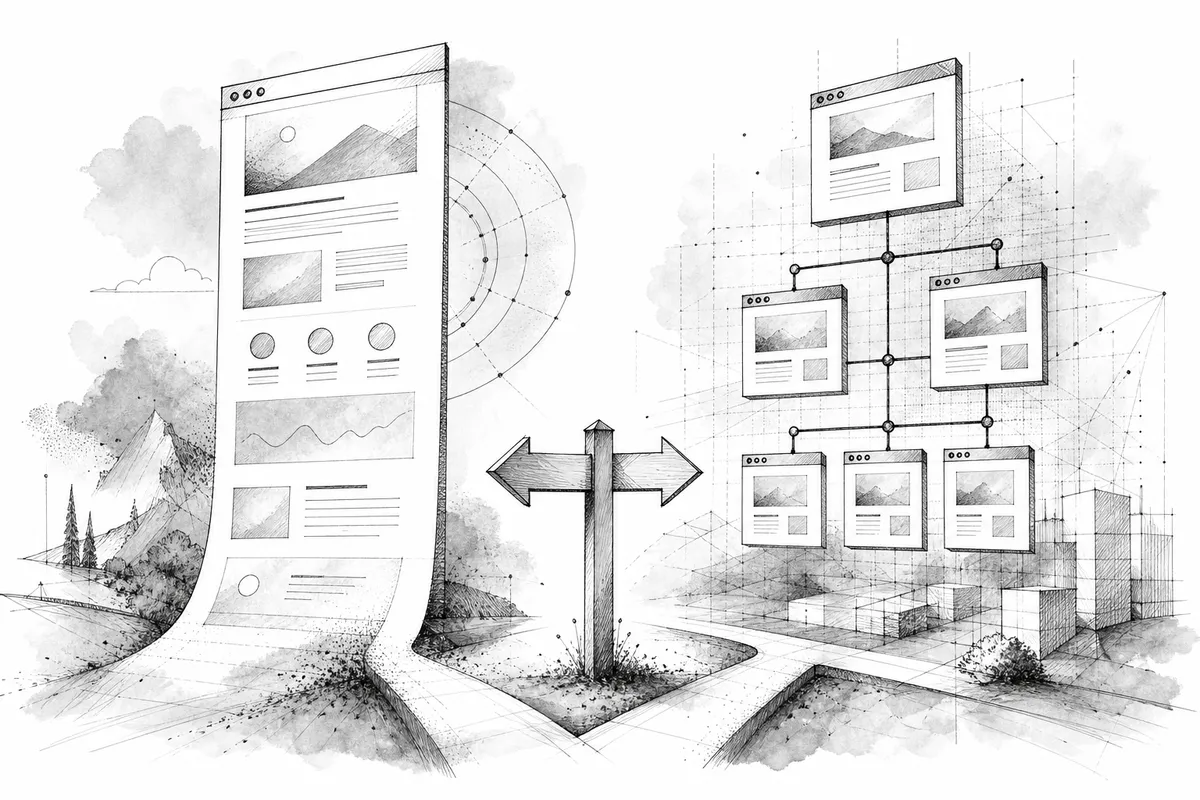
If the website needs to generate enquiries, a one-page site is usually the weaker choice for a trade business. It can still be right for a very narrow offer, a new business with one main service, or a referral-led business that only needs a simple online presence. But once the site has to support search, explain more than one service, or build trust for larger jobs, a multi-page structure is usually better.
The reason is straightforward: people do not visit a trade website to read a brand story from top to bottom. They arrive with a job in mind. Separate pages make it easier to show the service, the area covered, proof of work and the next step without forcing everything into one long scroll.
When a one-page site is enough
A one-page site can work if the business has one clear offer and one clear audience. A sole trader fitting one type of product, or a new business that mainly needs a phone number, a short service summary and a contact form, may not need anything more complicated.
It is also easier to launch. There is less copy to write, fewer pages to maintain and fewer decisions about structure. If most work comes through recommendations rather than search, that simplicity may be acceptable.
The limit is important: a one-page site gives every topic the same URL, so it has little room to separate services, locations and supporting proof. That makes it harder to target more than one search intent properly.
Why multi-page sites usually work better
A multi-page site gives each important subject its own space. That matters for both search and enquiries.
A plumbing business, for example, can have separate pages for boiler repairs, bathroom plumbing, leak detection and emergency callouts. A builder can separate extensions, renovations, new builds and garage conversions. That is easier for Google to understand, and it is easier for a customer to compare against other quotes.
It also lets the site answer different kinds of intent. Someone with a leak wants fast contact details and trust signals. Someone planning an extension wants process, photos and service-area coverage. Those are different jobs, so they should not be forced onto the same page.
That is why web design for trades is often about structure as much as visuals. The right structure usually means enough pages to support search and enquiries, but not so many that the site becomes difficult to manage.
A practical rule for deciding
A one-page site is probably enough only when all of these are true:
- there is one main service
- the business serves one fairly narrow audience
- search visibility is not a major priority
- the site mainly supports referrals, signage or social profiles
If any two of those are false, a multi-page site is usually the safer choice.
A useful test is this: if a potential customer would need to scroll through unrelated content to find the service they want, the page is doing too much work. Separate pages are the better answer.
What to build first
For most trade businesses, the starting structure should be:
- Home page
- Individual service pages
- About page
- Contact page
- Location or area pages only where there is a genuine search need
That gives a clear path from search to enquiry. It also makes future changes easier, because new services can be added without turning the homepage into a wall of text.
If an existing site already feels cramped or flat, a redesign is often the cleaner fix. Website redesign is usually the point where page structure should be sorted properly, rather than patched with more sections on the homepage.
Where the site needs to be kept up to date after launch, ongoing website management can handle content updates, technical fixes and small SEO changes without letting the site drift.
A one-page site is not automatically wrong. It is just the wrong shape for many trade businesses. When the goal is more enquiries, clearer service pages and better local search visibility, a multi-page site is usually the better investment.