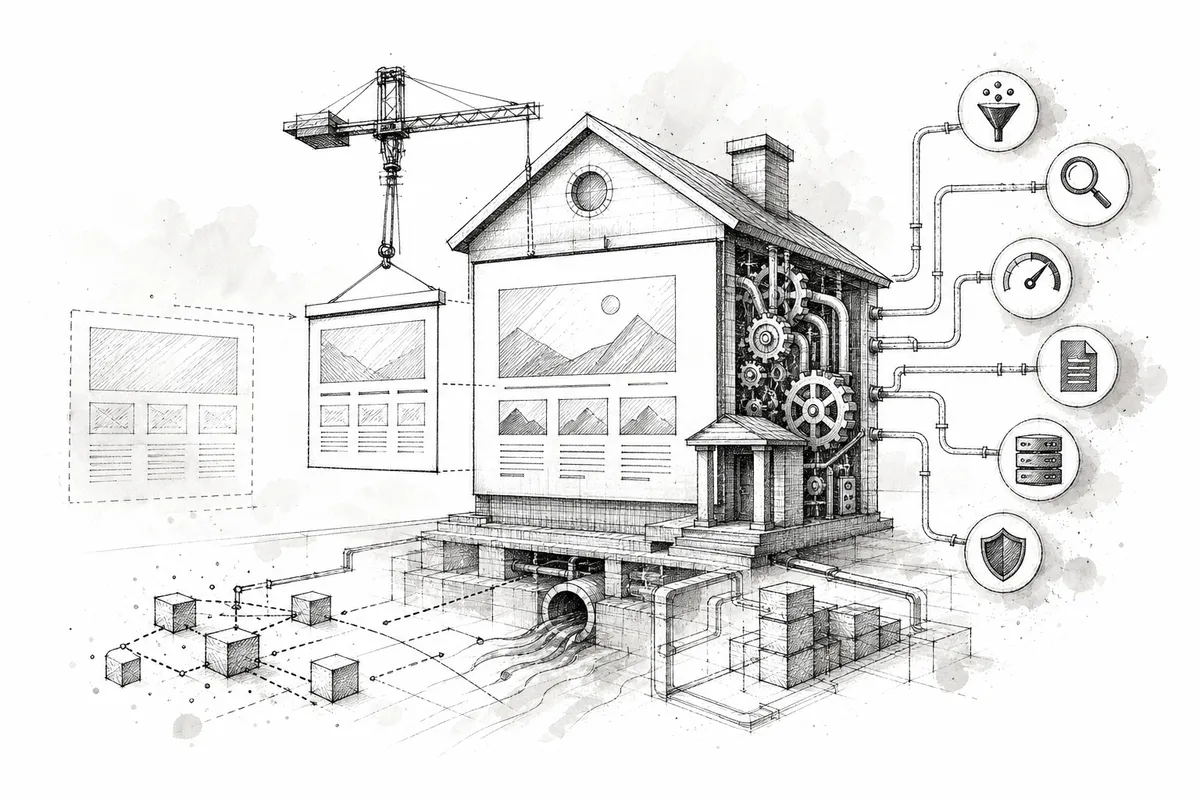
A homepage redesign for small business website is worth doing only when the page does not explain what the business does, who it helps, and what happens next. If the real problem is low traffic, thin service pages, weak local visibility or a broken enquiry form, a new homepage will not create enquiries by itself.
Check the homepage first
A small business homepage has three jobs: orient the visitor, build trust quickly, and send them to the right next step.
Signs the homepage is the bottleneck:
- The main heading is vague, such as “Welcome” or “Quality service you can trust”, and never says the actual service.
- Several messages compete for attention: different services, different audiences, too many buttons, or a slideshow that hides the offer.
- The next step is unclear. Visitors have to hunt for the service page, contact details or quote form.
- Mobile layout forces too much scrolling before any real information appears.
- There are no trust signals near the top: location, reviews, accreditations, years trading, examples of work, or a clear service area.
Example: a Bradford builder homepage that starts with “Building dreams since 2009” but never says whether it handles extensions, kitchens or repairs is likely losing people on the spot.
Example: a trades homepage can look plain and still work well if it clearly states the service, shows the areas covered, links to each service page and makes the phone number and enquiry form obvious. Plain is not the same as ineffective.
When the problem is elsewhere
A weak homepage is not always the real issue. Three common cases get blamed on homepage design when the bottleneck sits somewhere else:
- Not enough traffic. If only a handful of relevant visitors reach the site each month, a redesign cannot manufacture demand. The problem is earlier in the process.
- Thin or confusing service pages. Many local sites send people from the homepage to pages that do not explain the work, answer basic questions or support the enquiry.
- A broken enquiry path. A form that fails, a missing phone link, or a clunky mobile contact page can kill enquiries even when the homepage is decent.
That is why one bad metric should never be treated as proof that the homepage is broken. For example, if people are landing on a service page from search and leaving there, the issue may be the service page rather than the homepage. In that situation, a homepage redesign is a distraction. A better starting point is often the problem described in why your website gets traffic but no enquiries.
Choose the smallest fix that matches the fault
If the homepage is weak, the fix is not always a full redesign.
- Cosmetic refresh: change colours, type, spacing and imagery when the message and structure already work but the site looks dated.
- Content restructure: rewrite the headline, tighten the copy, add trust signals, improve the call to action and simplify the route to service pages when visitors are confused.
- Full redesign: change the page structure, navigation, content hierarchy and enquiry flow when the homepage, service pages and contact path all support the wrong story.
That last case is where a proper website redesign becomes more sensible than patching the homepage in isolation. If the homepage is only one weak part of a wider site, a tidy-up may waste time and money while the real obstacles stay in place.
A practical decision rule
A homepage redesign is justified when a visitor cannot answer these three questions within a few seconds:
- What does this business do?
- Is this the right business for the job or customer?
- What should happen next?
If the answer is no, the homepage is likely blocking enquiries. If the answer is yes, but enquiries are still poor, the homepage is probably not the main problem and the site needs a wider check of traffic, service pages and the enquiry path. For a direct assessment, use the contact page and ask for a review of the homepage and the rest of the conversion path together.