A contact form should be the simplest part of a website. Someone fills it in, clicks send, and the enquiry lands where it should. But when that doesn’t happen, the business usually finds out late: missed leads, awkward follow-ups, and no clear idea where the problem started.
The short answer is this: most broken contact forms fail for boring reasons, not mysterious ones. It’s usually email delivery, form configuration, spam protection, browser issues, or a plugin conflict. Occasionally it’s a deeper website problem. Either way, a form that looks fine on the page can still be failing behind the scenes.
If enquiries matter to the business, the form needs proper checking, not just a quick glance after launch. That’s exactly the sort of thing covered under ongoing website management.
The usual reasons a contact form stops working
Most form problems fall into a small number of buckets:
- The email never leaves the site because the website isn’t set up to send mail reliably.
- The email arrives in spam or gets filtered out by the inbox provider.
- The form has a hidden error caused by a plugin update, theme change, or broken script.
- Spam protection is too aggressive and blocks real visitors.
- A required field is confusing or badly labelled, so people give up before submitting.
- The form says it sent, but nothing is actually delivered.
That last one is especially annoying. From the visitor’s point of view, everything seems fine. From the business’s point of view, the enquiry never arrived.
Why “it looks fine” isn’t good enough
A contact form can appear to work and still lose enquiries in practice.
For example:
- A visitor completes the form.
- The confirmation message appears.
- The website records the submission.
- The notification email never reaches the inbox.
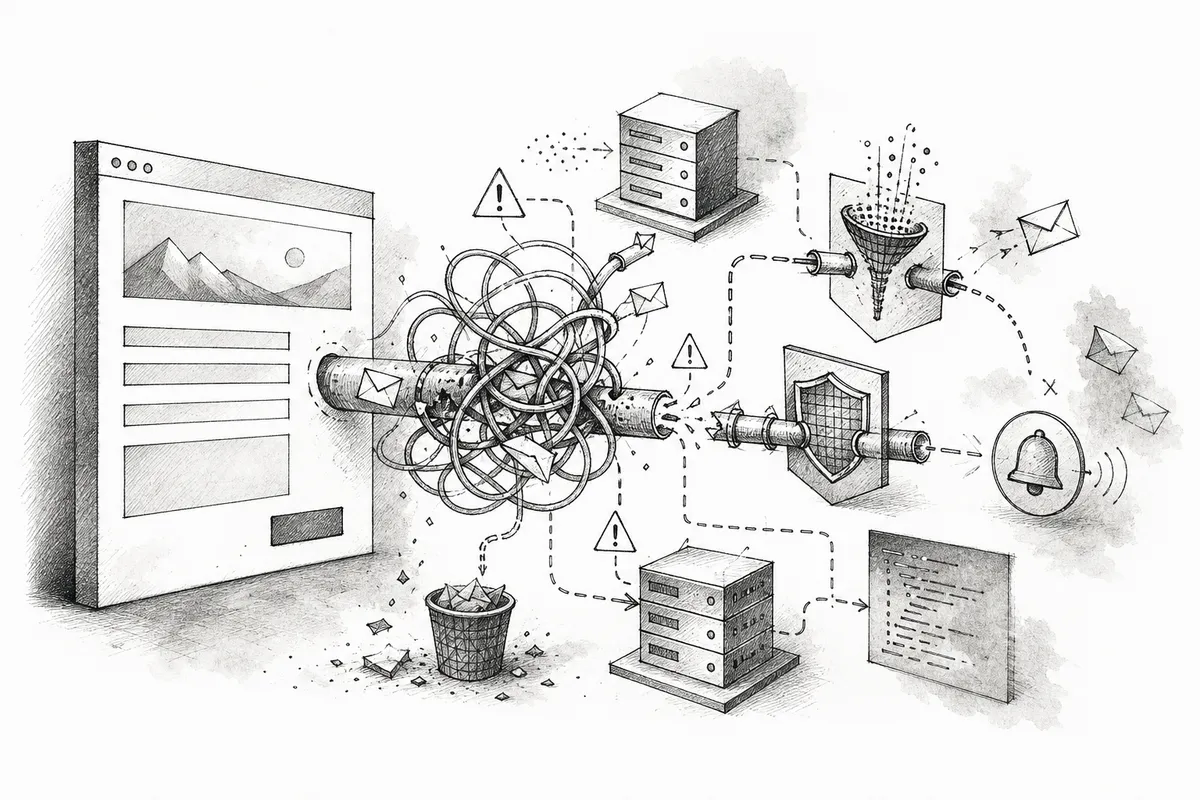
That’s a delivery problem, not a design problem. A lot of small business websites rely on basic email sending from the web server, which can be flaky. If the site can’t send messages reliably, the form is only half working.
This is one reason website management matters. Forms, updates, spam controls and inbox delivery all need checking over time, not just when the site first goes live. See what ongoing website management should actually include.
The first things to check
Before assuming the whole site is broken, check the basics.
1. Test the form properly
Don’t just submit it once.
Test it from:
- a desktop browser
- a mobile phone
- different email addresses
- different network connections if possible
If the form works on one device but not another, the problem may be browser-related or caused by a script conflict.
2. Check where the notification should go
A surprising number of forms are configured to send notifications to an old inbox, a typo’d email address, or a shared mailbox nobody watches anymore.
Check:
- the destination email address
- any CC or BCC rules
- whether replies go to the right address
- whether the sender name makes sense
3. Look in junk and spam folders
If the email lands in spam, the form may technically be working, but the enquiry still gets missed.
That’s not a minor issue. A business can’t rely on customers remembering to chase a reply that never arrives.
4. Review the spam protection
CAPTCHAs, honeypots and blocking rules are useful, but they can become too strict.
If genuine users are being told to “prove you are not a robot” over and over, or the form submits but does nothing, the protection may be doing more harm than good.
Email delivery is often the real problem
A website form and an inbox are two different systems. A form can be built correctly and still fail because the email handoff is weak.
That matters because many sites are still set up to send contact forms in a simple, old-fashioned way. That’s fine until it isn’t. Then the business gets silence instead of enquiries.
A more reliable setup usually means:
- proper email authentication
- a sensible sending method
- clean form code
- fewer unnecessary plugins
- better logging so failures can be traced
This doesn’t need to be complicated, but it does need to be deliberate. Bolting on another plugin and hoping for the best is not a strategy.
When the form is fine, but the user experience isn’t
Sometimes the form isn’t technically broken. It’s just bad at converting visitors.
Common problems include:
- too many fields
- unclear labels
- vague error messages
- no reassurance about response times
- hidden phone numbers or email addresses
- a mobile layout that’s awkward to use
People often abandon a form when it asks for too much too soon. If a local service business only needs a name, contact details and a brief message, asking for a full life story is unnecessary friction.
For many businesses, a better form means fewer enquiries lost at the final step. That’s a design and content issue as much as a technical one.
Signs the issue is bigger than the form
If more than one part of the website is acting strangely, the form may just be the symptom.
Watch for:
- slow page loading
- login problems in WordPress
- plugin errors after updates
- pages breaking on mobile
- random layout changes
- security warnings from browsers
When those start showing up together, the site may need broader maintenance or a cleanup. A form problem can be the first visible sign that the website is running on too many moving parts.
A useful related read is how to tell if your website has been hacked. Not every form fault is caused by malware, but it’s a mistake to ignore unusual behaviour.
What a proper fix usually involves
A proper fix depends on what’s actually failing, but the usual process is straightforward:
- Test the form submission path from start to finish.
- Check the destination inboxes and mail rules.
- Review spam filtering and anti-bot controls.
- Inspect plugin and theme conflicts.
- Confirm mobile usability and error handling.
- Set up monitoring so failures are spotted early.
The important bit is not patching the symptom and moving on. If the problem comes back, it will cost more in missed work than the fix cost in the first place.
If the website is older, the form may not be the only weak spot
Older WordPress sites often accumulate form builders, security tools, cache plugins and tracking scripts over time. Each one might be useful on its own. Together, they can make the site harder to trust.
That’s one reason some websites are better treated as maintenance projects rather than one-off builds. If a site needs regular attention to keep enquiries flowing, a managed setup is usually less stressful than firefighting every few months. Solid Digital’s website management service is built around that kind of practical upkeep.
If the form is only one part of a larger problem, a full website redesign may be the cleaner option. If the site is still broadly sound, a targeted fix is often enough.
How to reduce the chance of losing enquiries again
A few habits make a big difference:
- Test forms after every major update
- Use inboxes that are monitored properly
- Keep form fields as short as possible
- Avoid stacking too many plugins onto one task
- Check mobile submissions, not just desktop
- Review spam settings when enquiry volume changes
That may sound basic, but basic is what keeps leads coming in. Websites fail quietly more often than they fail dramatically.
The practical takeaway
If a website contact form is losing enquiries, don’t assume the answer is a redesign or a brand-new site. Start by checking the form, the email delivery path, and the surrounding website setup.
Most problems are fixable once the real cause is found. The risk is leaving it alone and letting missed enquiries pile up.
For businesses that depend on enquiries, forms need the same level of attention as hosting, updates and security. If the site is supposed to bring in work, it should be checked like it matters.