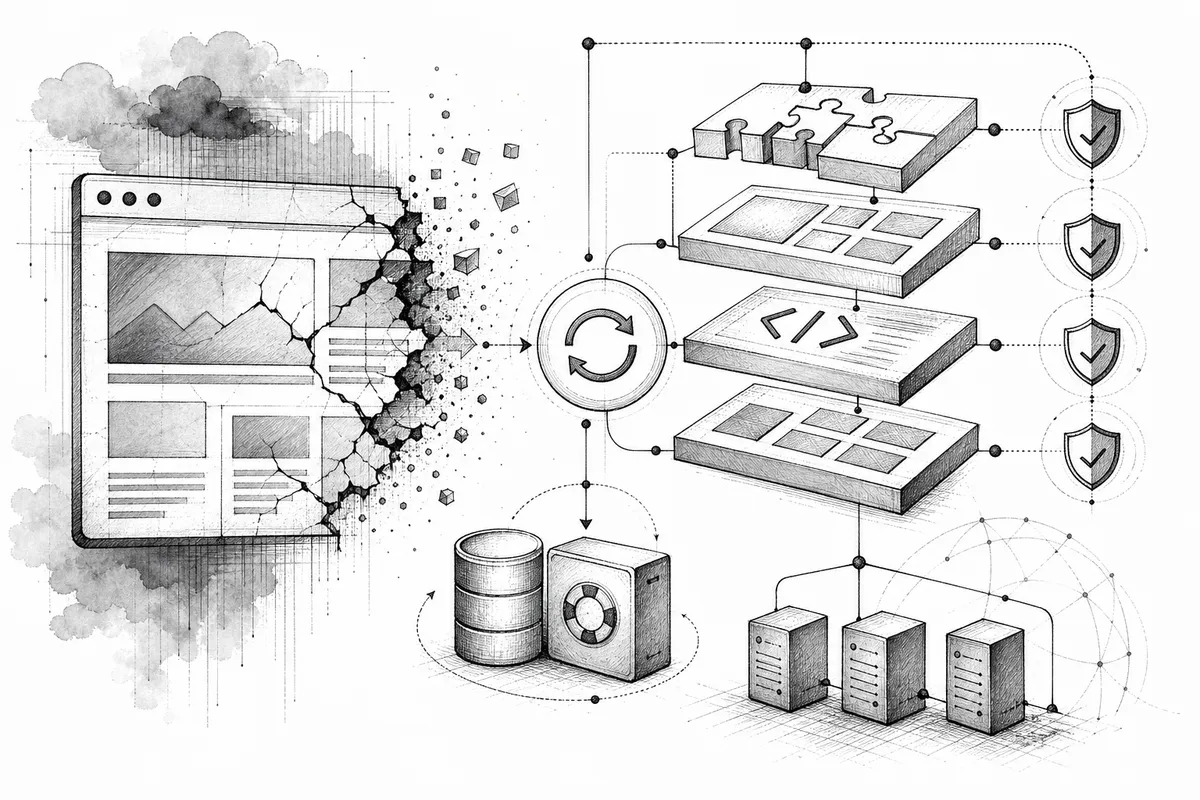
If WordPress updates keep breaking parts of a site, the short answer is this: the site is fragile, not the update.
That sounds blunt, but it’s usually the truth. WordPress itself is rarely the problem. The trouble is the pile of plugins, old theme code, page builder layouts, custom snippets and half-finished fixes sitting on top of it. One update nudges the system and something snaps.
That’s why website management matters. Not because updates are scary, but because unmanaged WordPress sites tend to become a patchwork of things that only work as long as nothing changes. The moment core, a plugin or PHP moves on, cracks appear.
What usually breaks after a WordPress update?
The most common issues are predictable:
- Layout changes — spacing shifts, sections move, buttons disappear or columns stack badly.
- Forms stop working — enquiry forms fail to send, reset emails vanish or spam protection gets too aggressive.
- Plugins conflict — one plugin updates, another doesn’t like it, and a feature stops responding.
- Checkout problems — on WooCommerce sites, payment gateways, shipping rules or basket pages can fail.
- Styling glitches — fonts, colours or mobile views break because the theme and builder are no longer in sync.
- White screens or fatal errors — usually a sign of old code, incompatible PHP or a bad plugin interaction.
None of that is unusual. It’s just what happens when a site hasn’t been kept in good shape.
The real cause: too many moving parts
A basic WordPress site can stay stable for years. The problems start when the site grows without any clear maintenance plan.
Common causes include:
1. Too many plugins
Every plugin is another dependency. Some are well maintained. Some are abandoned. Some work fine until the next major update, then fall over.
2. Old themes and page builders
If a theme was built for an older version of WordPress or a heavy builder, updates can expose weak code and poor compatibility.
3. Custom code nobody fully owns
A quick snippet added years ago can keep a site limping along until a core update changes how it behaves.
4. Infrequent updates
Leaving everything untouched for months is risky. Big jumps are harder to test and more likely to cause conflict.
5. No backup or staging process
If updates go live first and get checked later, the site becomes the test environment. That’s backwards.
For a site that brings in enquiries, that’s not just a technical issue. It’s a business risk. If forms break, sales stop. If checkout fails, revenue leaks. If the site looks broken on mobile, trust drops fast.
Why “just update everything” is bad advice
There’s a lazy bit of advice floating around: keep WordPress updated and everything will be fine.
That’s only half the story.
Yes, updates matter. They patch security holes, improve compatibility and often fix bugs. But blindly clicking update on a live business website is how many owners end up with a broken homepage at 9am on a Monday.
Proper management is about control, not panic. That means:
- knowing what each update affects,
- updating in the right order,
- checking for conflicts,
- testing the bits that actually matter,
- and rolling back quickly if something goes wrong.
That’s the difference between maintenance and firefighting.
If that sounds like the sort of thing a business owner shouldn’t have to babysit, that’s because they shouldn’t. A managed plan like ongoing website management is there to stop small technical issues turning into lost enquiries.
What a safer update process looks like
A sensible process doesn’t need to be fancy, but it does need to be consistent.
1) Back up first
A proper backup means the site can be restored if an update goes wrong. Not a vague promise that “the host has backups somewhere”, but a backup that can actually be used.
2) Update in the right order
Usually that means checking WordPress core, themes, plugins and server software as a whole rather than treating each one separately. Sometimes the problem is not the update itself, but the order it’s applied in.
3) Test the parts that matter
Don’t just glance at the homepage and call it done. Check the enquiry form, phone links, shop basket, mobile menu, key service pages and anything else that drives business.
4) Watch for silent failures
Some problems aren’t obvious. A form may still show on screen but emails stop arriving. A checkout may appear normal until a specific payment method is used. A plugin may throw errors only on mobile.
5) Remove what’s no longer needed
If a plugin has been replaced, delete it. If a feature is duplicated in three places, simplify it. The fewer moving parts, the less likely something is to break next time.
When a site needs more than maintenance
Sometimes updates keep breaking things because the site is overdue for a proper rebuild or redesign.
That’s especially true when:
- the theme is old and heavily modified,
- the page builder is slowing everything down,
- plugins are stacked on top of each other for basic features,
- the site is hard to edit without breaking the layout,
- or every fix feels like a temporary patch.
At that point, more updates won’t solve the root problem. They’ll just keep exposing it.
This is where a website redesign makes more sense than endless maintenance on a fragile setup. A cleaner build is usually easier to manage, easier to secure and less likely to collapse every time WordPress moves on.
Why unmanaged sites cost more in the end
Website owners often try to save money by leaving updates alone until there’s a problem. That usually backfires.
The real costs show up as:
- emergency fixes,
- lost leads,
- broken checkout flows,
- wasted time chasing plugin conflicts,
- and the stress of not knowing whether the site is actually working.
A site that breaks every few months isn’t cheap. It’s just being paid for in awkward, unpredictable ways.
That’s why regular management is usually better value than sporadic rescue work. It’s calmer, cheaper to run and far less likely to interrupt the business.
How to tell if the site needs proper help
A WordPress site probably needs managed support if:
- updates are delayed for weeks or months,
- nobody knows which plugin does what,
- the site has broken more than once after updates,
- forms or checkout have become unreliable,
- or the current developer has vanished and no one wants to touch the backend.
If that sounds familiar, the fix is not to stop updating. The fix is to put a proper process around it.
For businesses that want the site looked after without the constant guesswork, website management is the cleaner option than waiting for the next thing to break.
The practical takeaway
WordPress updates don’t usually break websites by themselves. Poor structure, outdated plugins, fragile themes and no maintenance process do that.
The answer is not to avoid updates. It’s to manage them properly, keep the site simple where possible and stop treating a live business website like a hobby project.
If the site keeps breaking after updates, that’s a sign the setup needs attention, not another quick fix. A stable site should support the business quietly, not create a fresh problem every month.
For a deeper look at related issues, it’s also worth reading why website speed matters more than most people think and WordPress security basics.