The short answer
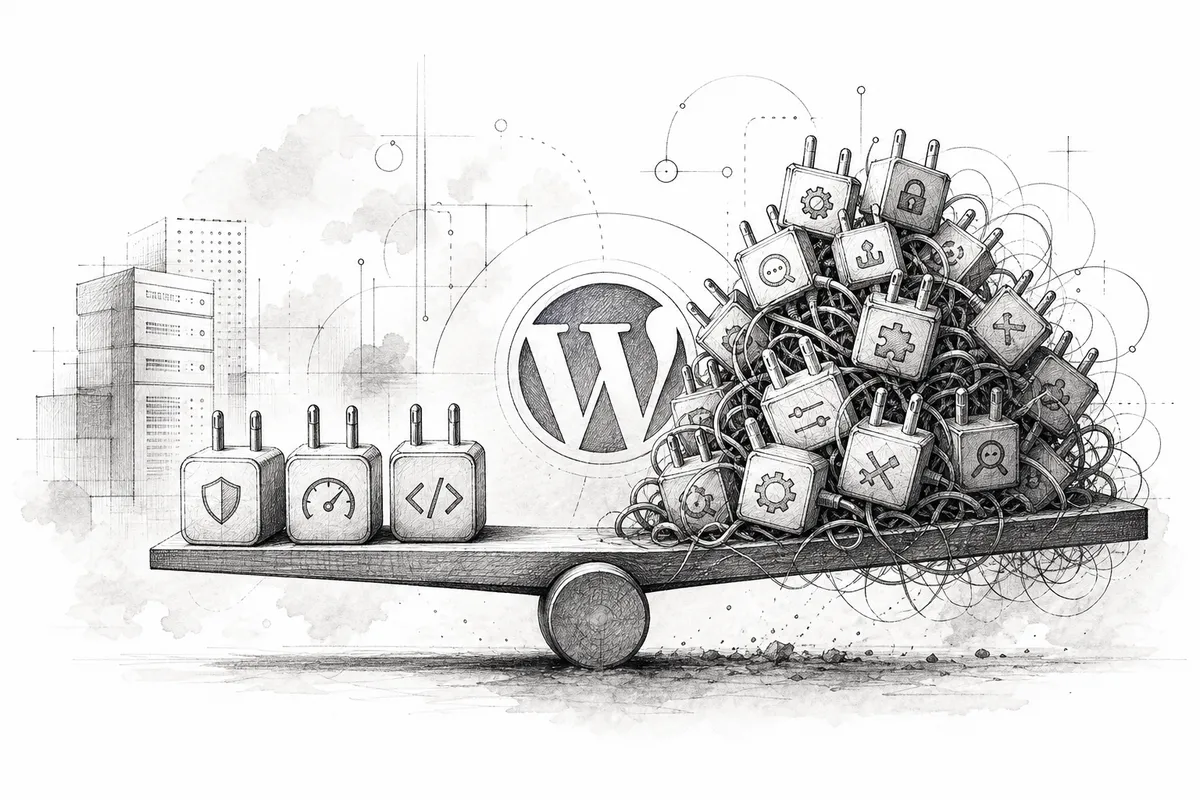
There isn’t a magic number. A WordPress site with 8 plugins can be a mess, and a site with 25 can be fine. What matters is what each plugin does, how well it’s maintained, and whether several of them are doing the same job.
The real problem isn’t “too many plugins” on its own. It’s too many unnecessary plugins, especially when they add extra code, extra admin work, extra update risk and extra chances for something to clash.
If a plugin only exists because a theme was badly built, or because a site has grown in a patchwork way over the years, that’s usually a sign the site needs tidying up rather than another quick fix.
What plugins actually cost you
A plugin can be free and still be expensive.
Not in money, but in all the things that get ignored until something breaks:
- Speed — more code can mean more requests, more scripts and more load time.
- Security — every extra plugin is another thing that can have a vulnerability.
- Maintenance — more plugins mean more updates, more testing and more chances for conflicts.
- Reliability — one plugin update can knock out forms, layouts, checkout or tracking.
- Admin time — a site with 20 add-ons is harder to understand and harder to hand over.
That’s why a simple site can become awkward even when it still “works”. It starts to depend on too many moving parts.
Signs your site has too many plugins
A plugin count alone doesn’t tell the full story, but these signs usually do.
1. Several plugins overlap
This is the classic one. A site has one plugin for SEO, one for schema, one for redirects, one for meta titles, one for image optimisation and one for caching. Sometimes that’s fine. Often it’s messy.
If two plugins can change the same setting, they can conflict or undo each other. That leads to wasted time and strange behaviour that’s hard to trace.
2. Nobody knows why a plugin is there
If the answer to “what does this plugin do?” is vague, it probably deserves a review.
Old sites often collect plugins because someone once needed a feature. The feature got forgotten, but the plugin stayed. That’s dead weight.
3. Updates make the site feel fragile
A healthy site should not need a prayer every time plugins update.
If regular updates cause layout issues, form failures or admin errors, the site has likely become too dependent on third-party add-ons or an unstable theme setup. That’s not normal upkeep; that’s technical debt.
See also: why WordPress sites keep breaking after updates.
4. Page speed gets worse for no obvious reason
Plugins do not always hurt speed, but many do add scripts, styles, database queries or front-end features that aren’t lightweight.
If the site is getting slower and there’s no clear design reason, plugin bloat is one of the first places to look. A slower site can mean fewer enquiries, lower trust and weaker visibility.
That links directly to why website speed matters more than most people think.
5. The site depends on plugins for basic content jobs
Some plugins are fair enough. A booking system, a payment gateway or a form builder may be necessary.
But if a website needs multiple plugins just to handle simple content, spacing, buttons or basic layout changes, the theme or build is doing too much the hard way.
A better way to judge plugins
Instead of asking “How many?”, ask these questions:
- Does this plugin do something the site genuinely needs?
- Could the same job be done by the theme, core WordPress, or a simpler setup?
- Is it still maintained and compatible with current WordPress versions?
- Does it add public-facing code, admin clutter, or both?
- Would removing it affect enquiries, checkout, tracking or trust?
If a plugin passes all five, it probably earns its place.
If it only passes one or two, it may be there out of habit.
Which plugins are usually worth keeping
Some plugins are worth the overhead because they protect revenue or save time.
Typical examples include:
- Security tools that genuinely improve protection
- Backups that make recovery possible
- Caching or performance tools where they’re properly configured
- Forms if enquiries matter
- SEO plugins if they’re used sensibly and not stacked with duplicates
- Ecommerce plugins such as WooCommerce when selling online
- Booking, membership or multilingual tools where the business genuinely needs them
If the plugin is tied to a core business function, its existence is easier to justify.
Which plugins are usually easy to question
These are the ones that often get left in place because nobody wants to touch them:
- Old slider plugins
- Duplicate page builders or block add-ons
- Extra analytics or tracking helpers that don’t get used
- Multiple image optimisation plugins doing similar jobs
- Redundant backup plugins
- Social sharing plugins with little real value
- One-off “fix” plugins for problems that should have been solved properly in the build
A plugin isn’t automatically bad just because it’s old or popular. But if it no longer earns its keep, it becomes clutter.
What happens when a site is over-plugins
An over-plugined site usually does not fail all at once. It drifts.
First the admin area gets busier. Then updates take longer. Then one change causes another issue. Then nobody wants to edit the site because it feels risky.
That matters for small businesses because websites are not museum pieces. They need to be easy to run.
If staff avoid making changes, the site goes out of date. If enquiries rely on forms that have become fragile, leads can be missed. If performance drops, visitors leave before they even see the offer.
That is why ongoing website management is not just about “keeping things updated”. It’s about reducing risk and keeping the site usable.
How to simplify a WordPress site without breaking it
Stripping plugins out blindly is a bad idea. A proper tidy-up needs a bit of care.
Step 1: List what each plugin does
Make a simple inventory:
- plugin name
- what it’s for
- whether it affects the front end, the back end, or both
- whether the business still needs it
That alone usually exposes duplicates and forgotten add-ons.
Step 2: Check for overlap
Look for jobs that are being done twice, such as:
- two SEO plugins
- two caching layers
- two form systems
- two backup tools
- page builder extras that duplicate theme features
Overlap creates confusion and can cause hidden conflicts.
Step 3: Test what happens if one is removed
Not on the live site without care. The sensible route is to test properly first.
If removing a plugin breaks a layout or feature, that tells a story: the site may have been built around a crutch rather than a solid structure.
Step 4: Replace plugins with cleaner built-in options where possible
WordPress core handles more than many people realise.
Some things are better handled by:
- the block editor
- the theme itself
- custom code for a specific requirement
- a single, well-chosen plugin instead of several fragmented ones
This is where a lighter build often pays off.
When to rebuild instead of keep patching
Sometimes the plugin mess is only a symptom.
If a site needs a pile of plugins just to behave normally, the cheaper option over time may be a rebuild or redesign rather than endless patching. That’s especially true when the site is slow, hard to edit, hard to secure and hard to trust.
A simpler rebuild can reduce dependency on third-party extras and make future management easier. That’s one reason some sites are better suited to a cleaner WordPress setup, and others are better suited to a different stack entirely.
If a site is reaching that point, a website redesign or rebuild is worth considering before another round of add-ons makes things worse.
The practical rule of thumb
A good WordPress site usually has as few plugins as necessary, not as few as possible.
That’s the part many agencies skip. They either stuff a site with generic add-ons because it’s easy, or they pretend every plugin is a disaster. Neither view is useful.
The right number is the number that supports the business without creating avoidable risk.
For a brochure site, that might be a small handful. For a content-heavy site, it might be more. For ecommerce, it will usually be more again because checkout, shipping, tax, payments and inventory all need proper handling.
Final take
If a WordPress site feels bloated, don’t obsess over the plugin count. Look at what each plugin is doing, whether it overlaps with something else, and whether it’s making the site slower, riskier or harder to manage.
A tidy site is usually easier to update, easier to secure and easier to trust. That matters more than having a neat number in the dashboard.
If a site needs a proper review, the sensible next step is a clean management plan or a rebuild that removes the clutter instead of adding to it. The website management service page covers the kind of ongoing support that keeps that from turning into a monthly firefight.